
Router Tables & Lifts
Collection: Router Tables & Lifts
Router tables and lifts are essential workstations for any cabinet shop, millwork operation, or serious woodworking facility. A router table transforms a handheld router into a stationary tool, enabling precise edge work, panel routing, and production-run repetition that would be dangerous or impractical with a portable router. Router lifts—whether manual or powered—allow you to adjust bit height safely from above the table without reaching underneath, improving accuracy and operator safety. Pittsburgh Spray Equipment carries industrial-grade options from Grizzly and Grizzly Industrial, manufacturers known for heavy-duty cast-iron construction and reliable lift mechanisms. Whether you're choosing a sliding table for wide stock, a mobile workstation for flexible shop layouts, or a precision lift system with electronic controls, the right router table reduces setup time, improves edge quality, and pays for itself through faster job turnaround and fewer mistakes.
How to Choose the Right Router Tables & Lifts
- Router horsepower: 1–3.5 HP typical; match to bit size, wood species, and depth-of-cut requirements.
- Lift type: manual crank, pneumatic, or electric touch-screen; electric lifts reduce fatigue on production runs.
- Table surface: cast iron or phenolic; cast iron superior for flatness and durability, especially hardwoods.
- Table dimensions and wing extensions: larger tables handle longer stock; wings add support for panels.
- Voltage and phase availability: confirm 110V single-phase or 220V three-phase in your shop before purchase.
- Mobility: check if base is mobile with locking casters; critical for shops with limited floor space.
- Dust collection port: 4-inch minimum; essential for shop safety and tool longevity with fine hardwood.
Model Comparison
| Model | Table Surface / Wings | Lift System | Motor / HP | Approx. Price Range |
|---|---|---|---|---|
| Grizzly Industrial Sliding Router Table | Cast-iron sliding surface; extends for long stock | Manual crank lift | 1.75 HP, 110V single-phase | $1,500–$1,800 |
| Mobile Router Table Workstation | Cast-iron top; four-way wings; mobile base with casters | Manual precision crank | 2 HP, 110V single-phase | $1,200–$1,600 |
| Grizzly T28781 — Router Table with Lift and Cast-Iron Wings | Cast-iron wings and table; rigid construction | Manual lift with fine-adjust knob | 2–2.25 HP capacity | $1,400–$1,700 |
| Grizzly T28780 — Router Table with Lift | Cast-iron top; standard wing configuration | Manual lift, easy height control | 2 HP, 110V single-phase | $1,100–$1,400 |
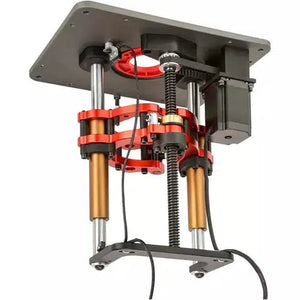
| Grizzly T1255 — Automatic Router Lift with Touch-Screen | Cast-iron surface; compatible with existing tables | Electric lift; digital height readout and preset positions | Up to 3.5 HP router compatibility | $2,200–$2,800 |
Frequently Asked Questions
What horsepower router do I need for hardwoods and large bits?
For hardwoods (oak, maple, walnut) and bits over 2 inches in diameter, use 2.25–3.5 HP minimum. Larger bits create more resistance; underpowered motors stall and burn edges. Softwoods (pine, poplar) can run 1.75 HP safely. Match HP to bit diameter and depth per the router or bit manufacturer's recommendation.
Do I need three-phase power, or will 110V single-phase work for a router table?
Most hobby and small-shop router tables run 110V single-phase. Three-phase is rarely necessary for routers under 3 HP. Check the motor nameplate on your specific unit. If your shop has three-phase available, you have flexibility; if not, single-phase Grizzly models are the practical choice and perform identically.
How much does a manual crank lift improve accuracy versus a handheld router?
A crank or powered lift allows micro-adjustments (often 1/32 inch or finer) without moving the router, eliminating hand-tremor and providing repeatable depth. For edge banding, panel work, or molded profiles, this means consistent results across hundreds of feet. Handheld routers introduce operator variation; tables eliminate that variable.
Is an electric lift worth the cost over a manual crank?
Electric lifts (like the Grizzly T1255) pay dividends on production runs: less operator fatigue, faster setup with digital presets, and fewer height mistakes. For one-off jobs, a manual crank is sufficient. High-volume shops or those running 8+ hours daily see ROI within one season through speed and reduced scrap.
What size table do I need—does wing size matter?
Table size depends on stock width: small panels need 24–36 inches; wider stock requires 48+ inches or sliding extensions. Cast-iron wings matter because they support long workpieces and reduce chatter. Undersized wings cause edge drift and tearout. Choose based on your typical job, not future plans; buy extensions only if you're certain you'll use them.
-
Grizzly T1255 - Automatic Router Lift with Touch-Screen Controls

- Regular price
- $810.00
- Sale price
- $810.00


