
Metal Lathes
Collection: Metal Lathes
Metal lathes are precision machine tools essential for turning, threading, and finishing ferrous and non-ferrous workpieces in job shops, tool rooms, gunsmiths, and small manufacturing operations. Whether you're producing small-diameter precision parts or larger diameter work, selecting the right lathe depends on swing capacity, bed length, motor horsepower, and spindle speed range. Pittsburgh Spray Equipment stocks benchtop models for space-constrained shops—including the compact Grizzly 4" x 6" Micro Metal Lathe—through mid-sized production lathes like the 18" x 60" South Bend Turn-Nado EVS with digital readout. Grizzly and Grizzly Industrial offer variable-speed benchtop lathes (8" x 16" through 12" x 36") with modern conveniences like two-axis DRO and milling head attachments, while South Bend delivers traditional heavy-duty construction. Each brand brings different trade-offs: Grizzly emphasizes affordability and feature-density; South Bend prioritizes longevity and rigidity. We help shops right-size capacity, phase availability, and footprint to match production demands.
How to Choose the Right Metal Lathes
- Verify swing capacity (distance from spindle centerline to bed) matches your largest workpiece diameter.
- Confirm bed length accommodates part length plus room for chuck, tailstock, and tooling.
- Check motor horsepower (typically 1–2 HP benchtop, 3+ HP mid-size) for material hardness and cut depth.
- Confirm single-phase or three-phase power availability; most benchtop models run 110V or 220V single-phase.
- Review spindle speed range (RPM); variable-speed models offer broader material versatility than fixed-speed.
- Evaluate footprint and weight—benchtop models fit tight spaces; floor-standing lathes require dedicated foundation.
- Assess digital readout (DRO) option if repeatability and thread-cutting precision are critical to your workflow.
Model Comparison
| Model | Swing × Bed Length | Motor HP / Phase | Key Features |
|---|---|---|---|
| Grizzly Industrial 4" x 6" Micro Metal Lathe | 4" swing × 6" bed | 0.5 HP / 110V single-phase | Compact benchtop; ideal for small parts, jewelers, hobbyists |
| Grizzly G4000 9" x 19" Bench Lathe | 9" swing × 19" bed | 1 HP / 110V single-phase | Entry-level benchtop; variable-speed spindle |
| Grizzly Industrial 10" x 22" Benchtop Metal Lathe | 10" swing × 22" bed | 1.5 HP / 220V single-phase | Mid-capacity benchtop; metric and inch threading |
| Grizzly G4003G 12" x 36" Gunsmithing Lathe with Stand | 12" swing × 36" bed | 2 HP / 220V single-phase | Specialized for gun barrel work; includes stand; precise spindle bearings |
| South Bend 18" x 60" Turn-Nado EVS with DRO | 18" swing × 60" bed | 3 HP / 220V three-phase | Production-grade rigidity; two-axis DRO; heavy-duty spindle bearings |
Frequently Asked Questions
What swing and bed length do I need for general job shop work?
Most job shops benefit from 10"–12" swing and 20"–36" bed length. This handles typical components up to 5" diameter and 18"–30" length. If you regularly turn larger shafts or sleeves, step up to 14"–18" swing. Measure your typical workpiece before deciding; oversizing wastes floor space and cost.
Can I run a Grizzly Industrial 10" x 22" lathe on single-phase 220V garage power?
Yes. The Grizzly Industrial 10" x 22" and most benchtop models operate on single-phase 220V (two-leg service common in garages and small shops). Three-phase machines like the South Bend 18" x 60" require three-leg industrial service or a phase converter, adding cost and complexity.
What horsepower do I need for steel versus aluminum turning?
Aluminum cuts cleanly at lighter depths with 0.5–1 HP; steel and stainless require 1.5–2 HP minimum to absorb cutting forces without chatter. The Grizzly 12" x 36" Gunsmithing Lathe's 2 HP handles steel threading and interrupted cuts well. Underpowered machines stall, overheat motors, and produce poor finishes.
Should I buy a lathe with DRO or manual handwheels?
DRO (like the Grizzly G0752Z and South Bend Turn-Nado) cuts setup time and improves thread-pitch consistency, justifying cost if you run repeatable batches. Manual machines cost less and suit one-off work and threading by feel. Consider your production mix and operator experience before upgrading.
How do variable-speed and fixed-speed spindles differ in practice?
Variable-speed lathes (found in most Grizzly benchtop models) let you optimize RPM for material and tool type—higher speeds for aluminum, lower for steel. Fixed-speed models limit flexibility and often require stepped pulleys. Variable-speed is standard on modern machines and reduces tool breakage and finish issues.
-
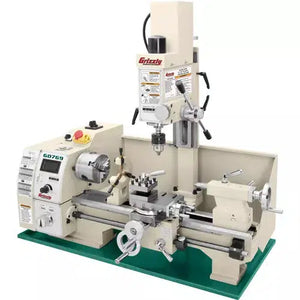
Grizzly Industrial 8" x 16" Variable-Speed Lathe with Milling Head

- Regular price
- $2,949.99
- Sale price
- $2,949.99
-
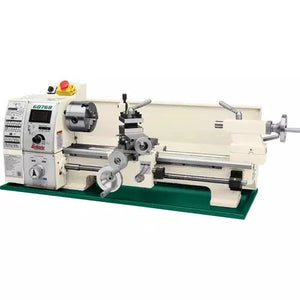
Grizzly Industrial 8" x 16" Variable-Speed Benchtop Lathe

- Regular price
-
$2,524.21 - Sale price
- $2,049.99
-
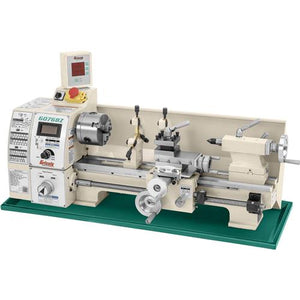
Grizzly Industrial 8" x 16" Variable-Speed Lathe with X/Z-Axis DRO

- Regular price
-
$2,899.33 - Sale price
- $2,499.99


