
Combination Machines
Collection: Combination Machines
Combination machines consolidate multiple operations into a single footprint—a critical advantage for shops with space constraints or budgets that can't accommodate standalone equipment. A combo lathe/mill handles turning, facing, and milling in one machine; a belt/disc sander combines edge and flat stock finishing; sheet metal combo units integrate shearing, brake, and roll functions. Pittsburgh Spray Equipment stocks industrial-grade combination machines from trusted manufacturers including Grizzly, Grizzly Industrial, South Bend, and Baileigh Industrial. These brands deliver precision and reliability at price points accessible to job shops, fabricators, and tool rooms. Whether you're running a 2,000 sq ft shop or a production facility optimizing floor space, the right combination machine eliminates tool changes, reduces setup time, and improves workflow consistency. Our inventory spans benchtop units like the Grizzly G0937 6" × 10" combo lathe/mill through industrial-capacity machines like Baileigh's multi-function power hammer. Understanding motor HP, voltage requirements, and material capacity ensures you select equipment that matches your throughput and power infrastructure.
How to Choose the Right Combination Machines
- Measure available floor space and ceiling height; most combo machines require 3–6 feet width and 4–8 feet depth.
- Verify your facility's electrical service: 110V single-phase, 220V single-phase, or three-phase power supply and amperage capacity.
- Define primary materials and thickness tolerances—steel, aluminum, wood, or composites determine motor HP and spindle rigidity needs.
- Assess duty cycle: light intermittent use favors smaller HP (0.5–1 HP); continuous production demands 2–3 HP minimum.
- Check motor horsepower against your largest operation; underpowered machines stall under load and shorten spindle life.
- Confirm chuck capacity, spindle taper (MT2, R8, or CAT), and cutting tool compatibility with your existing inventory.
- Review warranty coverage (typically 1–3 years on frame and bearings) and local service availability for repairs.
Model Comparison
| Model | Primary Function(s) | Capacity / Swing | Motor HP / Voltage | Footprint Approx. |
|---|---|---|---|---|
| Grizzly G0937 | Lathe/Mill Combo | 6" × 10" swing | 0.75 HP / 110V single-phase | 3.5' × 4' (benchtop) |
| Grizzly G4015Z | Lathe/Mill Combo | 19-3/16" swing | 0.75 HP / 220V single-phase | 5' × 6' (floor mount) |
| Grizzly G9729 | Lathe/Mill Combo | 31" swing | 0.75 HP / 220V single-phase | 6' × 7' (floor mount) |
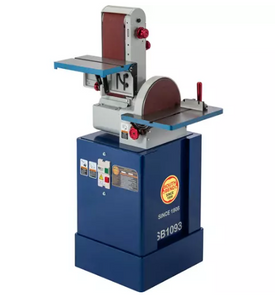
| Grizzly SB1093 | Belt/Disc Sander | 6" × 48" belt, 12" disc | 1 HP / 110V single-phase | 4' × 5' (benchtop/pedestal) |
| Grizzly T26472Z | 3-in-1 Sheet Metal | 12" wide capacity | 0.5 HP / 110V single-phase | 3.5' × 4' (benchtop) |
Frequently Asked Questions
What motor horsepower do I need for a lathe/mill combo handling mild steel and aluminum?
For intermittent production (under 40 hrs/week) in steel and soft aluminum, 0.75 HP is adequate if feed rates stay moderate. Continuous production or larger diameters (20"+ swing) benefits from 1.5–2 HP. Undersized motors stall under load, causing chatter and spindle wear. Grizzly's 0.75 HP combos suit small job shops; larger facilities often upgrade to 1.5+ HP.
Do I need three-phase power for a combination machine, or will 220V single-phase work?
Most benchtop and mid-range combo machines (like Grizzly's G4015Z and G9729) run on 220V single-phase, which is standard in most shops. Three-phase is required only for larger industrial models (3+ HP) and specialized machinery. Check the motor nameplate and power requirements before purchase. A phase converter is an expensive workaround; verify your facility voltage first.
How do Grizzly Industrial and South Bend combo machines compare in reliability for a small tool room?
Both brands deliver solid spindle rigidity and casting precision. South Bend machines often feature heavier hand-wheels and manual controls; Grizzly offers more variable-speed options and modern fixtures. Grizzly typically costs 10–20% less. For critical tolerances, both require rigorous setup and maintenance. Service parts for Grizzly are more readily available through Pittsburgh Spray Equipment.
Is a belt/disc sander combo worth the investment over separate machines?
Yes, if space is limited or budget constrains multiple purchases. The Grizzly SB1093 combines edge (belt) and flat (disc) finishing, eliminating tool changes and resetting. Drawback: you can't run both simultaneously. Larger shops with heavy throughput prefer separate machines for parallel workflow; small shops and prototypers benefit from combo flexibility.
What maintenance and tooling costs should I budget after purchasing a combo machine?
Budget 5–10% of purchase price annually for routine maintenance: spindle bearings, belts, coolant (if applicable), and chuck servicing. Tooling depends on operation: lathe chucks and collets ($200–500), mill end mills and collets ($300–800), sanding belts ($50–150 per set). OEM-spec parts from Pittsburgh Spray Equipment ensure compatibility and machine longevity.
-
Grizzly SB1093 - 6" X 48" Belt / 12" Disc Combination Sander

- Regular price
-
$2,543.57 - Sale price
- $2,049.99

